
Traditional Japanese Dishes
Japanese Tonkotsu Ramen
Prepare an authentic Japanese tonkotsu ramen at home with a white and silky pork bone broth, tender bacon, marinated egg, noodles, black mushrooms, nori, and scallions. It's a long-cooking recipe, but each stage adds depth, texture, and the comforting character of this Kyushu classic.
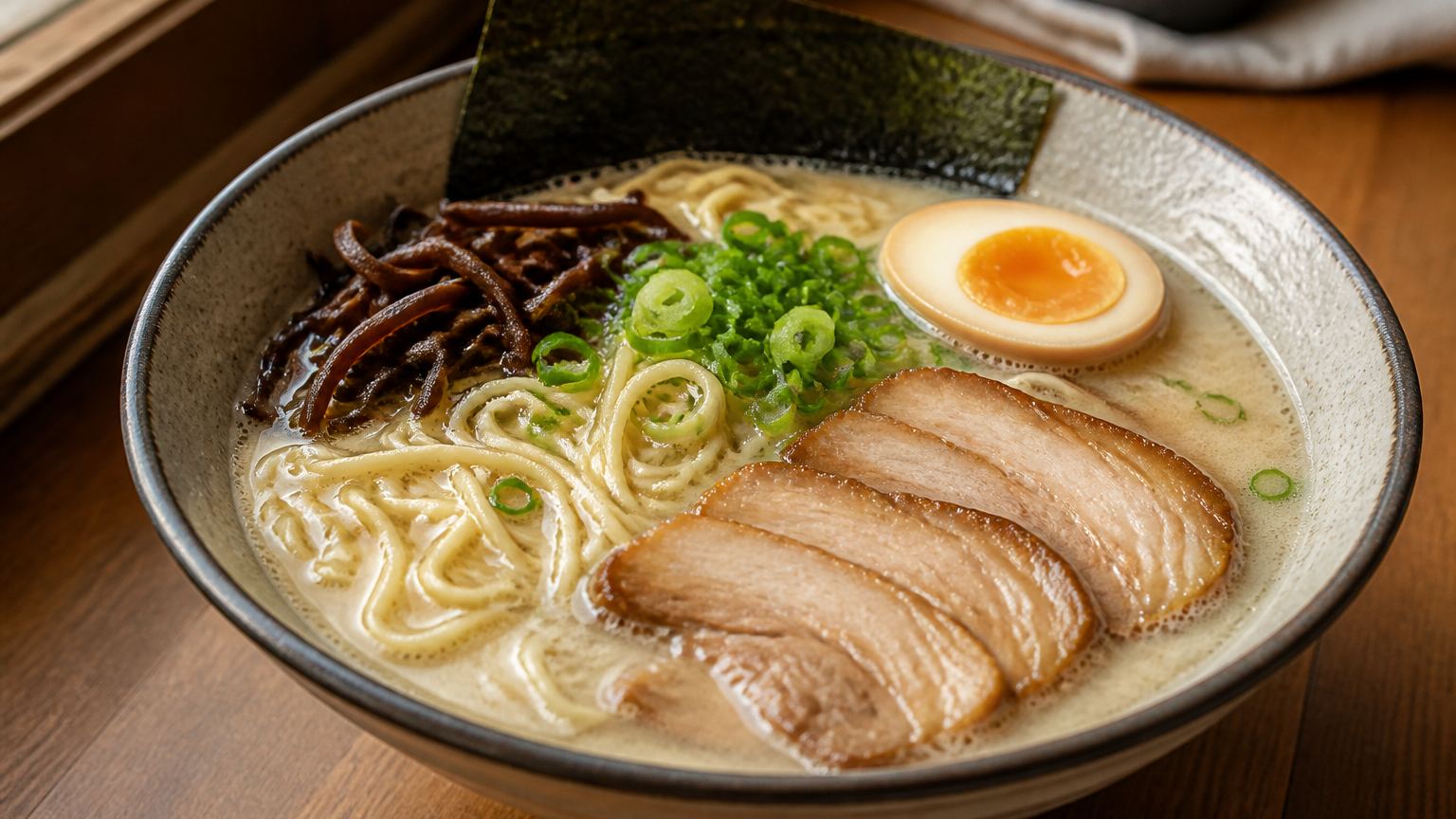
Tonkotsu is distinguished by its opaque and creamy broth, the result of boiling pork bones and trotters for several hours to emulsify the fat, collagen, and gelatin. The tare is added directly to each bowl, allowing the intensity of the flavor to be adjusted in each portion.
01
Ingredients
Have everything ready before you begin.
- ✓1.5 kg of pork bones
- ✓4 pork trotters, split
- ✓4 liters of water for the broth
- ✓1 onion
- ✓1 head of garlic
- ✓70 g of ginger
- ✓4 scallions, divided into 2 for the broth and 2 for serving
- ✓1 kombu sheet
- ✓400 g of pork belly
- ✓4 eggs
- ✓400 g of ramen noodles
- ✓100 g of dried black mushrooms
- ✓4 nori sheets
- ✓1 tablespoon of toasted sesame oil
- ✓120 ml of soy sauce
- ✓60 ml of mirin
- ✓2 tablespoons of sake
- ✓1 tablespoon of sugar
- ✓1 teaspoon of salt
02
Step-by-step method
- 01
Rinse the pork bones and trotters under cold water
Rinse the pork bones and trotters under cold water. Place them in a large pot, cover them with water, and boil for 10 minutes. Drain, discard the first water, and wash the pot and bones.
- 02
Return the bones and trotters to the pot and add the 4 liters of water
Return the bones and trotters to the pot and add the 4 liters of water. Bring to a strong boil and maintain an active boil for 8-10 hours. Check frequently and add hot water if the level drops too much, ensuring the bones remain covered.
- 03
After 6 hours of cooking, add the halved onion, the head of garlic cut transversely, the sliced ginger, and 2 scallions
After 6 hours of cooking, add the halved onion, the head of garlic cut transversely, the sliced ginger, and 2 scallions.
- 04
During the last 30 minutes, add the kombu sheet
During the last 30 minutes, add the kombu sheet. Remove it after that time to avoid dominating the flavor or adding a viscous texture.
- 05
Roll the pork belly into a cylinder and tie it with kitchen twine, or leave it in a compact block
Roll the pork belly into a cylinder and tie it with kitchen twine, or leave it in a compact block. Place it in a small pot, cover it with water, and cook over low heat for 1 hour and 30 minutes, until tender. Cool, slice, and reserve, covered.
- 06
Boil the eggs in boiling water for 6 minutes and 30 seconds
Boil the eggs in boiling water for 6 minutes and 30 seconds. Immediately transfer them to cold water, peel them carefully, and place them in a container with part of the soy sauce, mirin, sake, and sugar. Refrigerate for at least 4 hours, turning them once during marinating.
- 07
Rehydrate the dried black mushrooms in hot water for 20 minutes
Rehydrate the dried black mushrooms in hot water for 20 minutes. Drain, remove the hard parts, and cut them into strips. Slice the remaining 2 scallions into thin rings and cut the nori sheets into manageable pieces.
- 08
To prepare the tare, combine the remaining soy sauce, mirin, sake, sugar, and salt in a saucepan
To prepare the tare, combine the remaining soy sauce, mirin, sake, sugar, and salt in a saucepan. Heat over medium heat until the sugar dissolves, and simmer gently for 2 minutes. Turn off the heat and reserve.
- 09
When the broth is ready, remove the bones, trotters, and aromatics
When the broth is ready, remove the bones, trotters, and aromatics. Strain it if you prefer a finer texture. To reinforce the tonkotsu character, you can briefly blend part of the fat and liquid with an immersion blender, being careful not to splash. Keep the broth very hot.
- 10
Cook the ramen noodles according to the package instructions, preferably leaving them slightly firm
Cook the ramen noodles according to the package instructions, preferably leaving them slightly firm. Drain them well to avoid diluting the broth.
- 11
Heat the bowls with a little hot broth and discard that liquid
Heat the bowls with a little hot broth and discard that liquid. In each bowl, place a quarter of the tare and a quarter tablespoon of toasted sesame oil.
- 12
Add approximately half a liter of very hot tonkotsu broth to each bowl and mix
Add approximately half a liter of very hot tonkotsu broth to each bowl and mix. Add the noodles and arrange them. Complete with slices of pork belly, half a marinated egg, black mushrooms, scallions, and a piece of nori.
- 13
Serve immediately, while the ramen is steaming
Serve immediately, while the ramen is steaming. If the broth separates slightly, stir it before serving.
- Maintain an active boil during the prolonged cooking: the agitation helps to emulsify the fat and gelatin, producing the characteristic white broth.
- Add hot water as needed to keep the bones covered throughout the cooking process.
- Cook the noodles separately and serve them immediately to prevent them from becoming too soft.
- Season each bowl with tare instead of salting the entire pot; this allows you to adjust the intensity of each portion.
- If using a very intense soy sauce, reduce the amount of tare in each bowl slightly and adjust to taste at the end.
- If you can't find mirin, replace it with an additional tablespoon of sugar mixed with a little water.
- Fresh noodles are ideal, although specific dried ramen noodles also work.
- Be careful when tasting the broth: it retains a lot of heat even after turning off the heat.